
Unlocking Your Thumb: Effective Exercises for Trigger Thumb

Dumbbell Exercises for Strength and Definition: Unleash Your Back Power
November 2, 2024
Bouncing Back vs. Looking Up: Unpacking the Difference Between Resilience and Positive Attitude
November 13, 2024
Trigger thumb, also known as stenosing tenosynovitis, can be a real pain—literally. This condition occurs when the tendon that bends your thumb becomes inflamed, making it difficult to move smoothly. You might experience catching, locking, or a painful clicking sensation when trying to bend or straighten your thumb. While medical intervention might be necessary in some cases, regular exercise for trigger thumb can often help alleviate symptoms and improve thumb mobility. Interestingly, while hand exercises can ease trigger thumb, if you’re looking for a full-body workout to boost overall health, you might wonder what workout machine burns the most calories, as calorie-burning exercises can improve circulation and joint health.
Here’s a comprehensive guide to understanding and managing trigger thumb through exercise:
Understanding Trigger Thumb
Imagine the tendons in your hand as long, thin ropes that connect your muscles to your bones, allowing you to move your fingers and thumb. These tendons glide through sheaths, acting like tunnels, to ensure smooth movement. In trigger thumb, the sheath around the thumb tendon becomes inflamed and narrowed. This makes it difficult for the tendon to glide freely, causing the characteristic “triggering” sensation. To learn more about conditions like these and their treatments, you can explore Blog-collector blog for additional insights.
Who is at Risk?
While trigger thumb can affect anyone, some factors increase your risk:
- Repetitive hand motions: Jobs or hobbies that involve repetitive gripping, such as knitting, playing musical instruments, or using hand tools, can contribute to trigger thumb.
- Certain medical conditions: People with diabetes, rheumatoid arthritis, and hypothyroidism are more prone to developing trigger thumb.
- Gender and age: Trigger thumb is more common in women and individuals between the ages of 40 and 60.
Exercises to the Rescue
The good news is that many cases of trigger thumb respond well to conservative treatment, including targeted exercises. These exercises aim to:
- Reduce inflammation in the tendon sheath.
- Improve tendon gliding.
- Strengthen supporting muscles.
- Increase range of motion.
Here’s a step-by-step guide to some effective exercises:
- Thumb Flexion and Extension:
- Starting position: Hold your hand out in front of you, palm facing up.
- Action: Bend your thumb across your palm, trying to touch the base of your little finger. Hold for 5 seconds. Then, straighten your thumb out as far as you can. Hold for another 5 seconds.
- Repeat: 10-15 times, several times a day.
- Thumb Abduction and Adduction:
- Starting position: Hold your hand out in front of you, palm facing up.
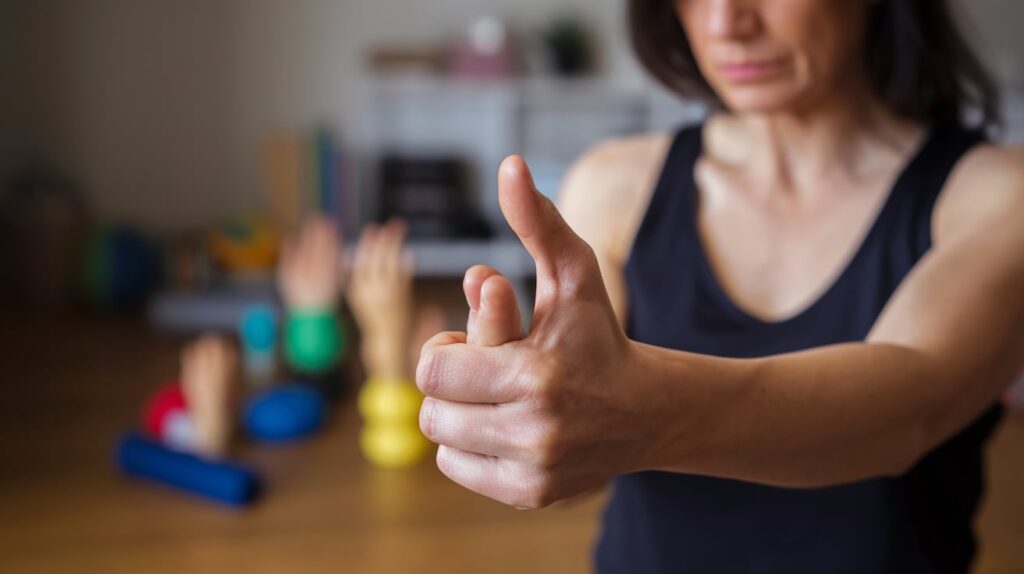
- Action: Move your thumb away from your palm, as if you were hitchhiking. Hold for 5 seconds. Then, bring your thumb back towards your palm. Hold for 5 seconds.
- Repeat: 10-15 times, several times a day.
- Thumb Circles:
- Starting position: Hold your hand out in front of you, palm facing up.
- Action: Make small circles with your thumb, first clockwise and then counterclockwise.
- Repeat: 10 circles in each direction, several times a day.
- Finger and Thumb Opposition:
- Starting position: Hold your hand out in front of you, palm facing up.
- Action: Touch the tip of your thumb to the tip of each finger, one at a time. Hold each touch for 5 seconds.
- Repeat: Complete the sequence 10-15 times, several times a day.
- Wrist Stretches:
- Starting position: Extend your arm in front of you, palm down.
- Action: Gently bend your wrist down, pointing your fingers towards the floor. Hold for 15 seconds. Then, bend your wrist up, pointing your fingers towards the ceiling. Hold for 15 seconds.
- Repeat: 10-15 times, several times a day.
- Tendon Gliding Exercises:
- Starting position: Make a fist with your hand.
- Action: Slowly straighten your fingers one by one, starting with your index finger. Then, slowly curl your fingers back into a fist, one by one.
- Repeat: 10-15 times, several times a day.
Read Also: Dumbbell Exercises for Strength and Definition
Visual Appeal and Human Writing Style

To make this information more engaging and accessible, consider these tips:
- Use clear headings and subheadings: This breaks up the text and makes it easier to scan.
- Incorporate visuals: Include images or illustrations demonstrating the exercises.
- Use a conversational tone: Write as if you are speaking directly to the reader.
- Offer practical advice: Provide tips on how to incorporate these exercises into daily life.
- End with a call to action: Encourage readers to try the exercises and seek medical advice if needed.
Important Considerations:
- Listen to your body: Stop any exercise that causes pain.
- Consistency is key: Perform the exercises regularly for best results.
- Combine with other treatments: Exercises are most effective when combined with other treatments like splinting, medication, or injections as recommended by your doctor.
- Seek professional guidance: If your symptoms are severe or don’t improve with exercise, consult a healthcare professional.
Beyond Exercises:
While exercises are crucial, remember that a holistic approach to managing trigger thumb often involves:
- Rest: Avoid activities that aggravate your symptoms.
- Splinting: Wearing a splint can help rest the thumb and reduce inflammation.
- Medications: Over-the-counter pain relievers or prescription anti-inflammatory drugs can help manage pain and swelling.
- Injections: Corticosteroid injections can be effective in reducing inflammation in the tendon sheath.
- Surgery: In severe cases, surgery might be necessary to release the tendon sheath.
By incorporating these exercise for trigger thumb into your daily routine and following your doctor’s recommendations, you can take a proactive role in managing your trigger thumb and regaining control of your hand.


